

The Ultimate Guide to Surviving a Friendship Breakup
Losing a friend can feel like a part of you is missing. It’s a unique kind of pain that often hits you like a ton of bricks. While our site might be full of fun friendship quiz tools designed to celebrate your bonds, the hard truth is that not all friendships last forever.
Losing a close friendship can be one of life’s most painful experiences. A platonic breakup can feel just as devastating as a romantic one.
There are no established rules or rituals for ending friendships, unlike romantic relationships. People often fail to offer support or encourage time off, which can make the experience isolating and confusing. With shared history and secrets, the loss may feel like losing part of yourself.
The truth is, deep friendship losses can be just as painful as, or even more so than, any other losses. You lost your confidant, inside-joke partner, and chosen family member. This is a serious loss, one that no simple friendship quiz can predict or fix. If you’re going through this, your feelings are valid. This guide will provide a clear path to help you navigate the pain, heal, and move forward.
Why Do Friendship Breakups Hurt So Much?
This kind of grief tends to be diminished within our society. Whenever you break up with someone, there comes a barrage of ice cream and sad movie-watching friends. However, they don’t know how to react when one loses a best friend. They say something like, “Just make new friends,” which is not helpful.
It’s not “just a friend.” Our close friends are woven into the fabric of our daily lives. They are the relationships we choose, without the obligations of family or the structure of a romantic partnership.
- Loss of a Confidant: You’ve lost the person you texted daily, the one who understood your past and was supposed to be in your future. They are the people we call with good news, who see us at our worst, and who are the keepers of our biggest secrets.
- Identity Crisis: Most especially in a very close “bestie” relationship, your identity may get intertwined with theirs. Their loss may make you question your identity without them.
- Physical Pain: This is not “all in your head”; your body really is suffering from a loss. Research has shown that social rejection can activate the same parts of the brain as physical pain. That’s why it feels so physically awful.
- Loss of a Support System: You’ve lost a key part of your support system, and the silence left behind can be deafening. When that relationship ends, you’re not just losing one person; you’re losing the shared history and the future you thought you’d have with them.
Common Reasons Why Friendships End
Understanding why a friendship ended can be key to healing. Sometimes, there just isn’t one clear reason. It’s just not like that bestie quiz where you get a simple score explaining what went wrong.
Friendships, like any relationship, are complicated and can end for many reasons:
- Drifting Apart: This is probably the most common reason. Life gets in the way. People move for jobs, get married, or have children. Priorities shift, and the daily contact that fueled the friendship fades. It is often a slow, quiet breakup with no big fight.
- A Breach of Trust: This is the more sudden, painful ending. A major betrayal—like lying, stealing, or talking behind your back—can sever a bond instantly. The thing is, trust is the foundation of friendship and, once it’s broken, it’s incredibly hard to repair.
- Mismatched Values: As you grow, your core values may change. You might find your views on life, ethics, or the future are just too different to maintain the connection.
- One-sided Effort: Sometimes, only one party puts in all the work, planning, and emotional support. Eventually, the person carrying the load gets tired and has to step away for their own well-being.
First Steps: How to Cope Immediately
Right after the breakup, the feelings can be overwhelming. The most important thing is to be kind to yourself. There is no “right” way to feel.
Allow Yourself to Grieve
Perhaps the most important first step is to give yourself permission to feel. Your feelings need to be acknowledged on your path to healing. You will be sad, angry, confused, or even numb. You might feel a messy mix of emotions:
- Sadness
- Anger
- Confusion
- Treason
- Guilt
- Even relief
All of these are normal. All of these are valid. Don’t let anyone, including yourself, tell you that you’re being “too dramatic” or to “just get over it.” You have to honor your feelings to process them. One user recently wrote to us saying, “Is it normal to cry over a friend?” And the answer, quite simply, is yes. Let yourself feel the grief.
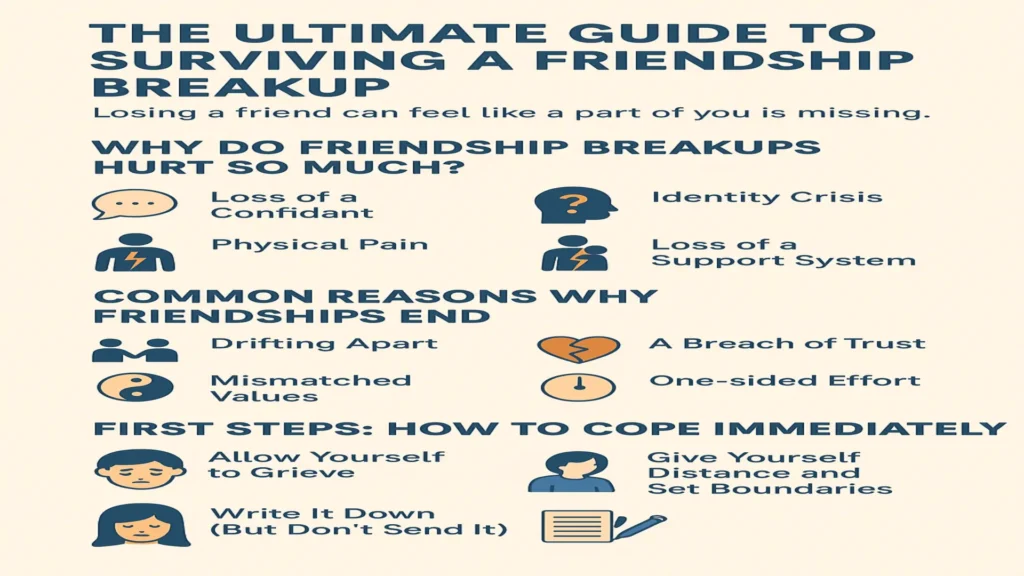
Give Yourself Distance and Set Boundaries
You need space to heal. This is especially the case with social media. It feels like salt in the wound to continue to see their updates pop up in your feeds.
- Mute or Unfollow: You don’t necessarily have to unfriend or block them, which can cause more drama. Instead, “mute” or “unfollow” them. This way, you eliminate them from your feed without the drama. It’s a healthy act of self-preservation.
- Don’t Stalk: The temptation might be there, but don’t stalk their profile. It will only prolong your pain.
- Let Mutual Friends Know: You could say, “I’m having issues with [Friend’s Name] and just need some space. If this is okay with you, can we spend time together without mentioning them for a little while?”
Write It Down (But Don’t Send It)
You probably have 1,000 things you want to say. Write it out in a journal or a document. Get all the anger and sadness out of your system. It is for you and only you. It helps process the emotions without creating more conflict.
Navigating the Aftermath: Healing and Moving On
Healing after a friendship breakup is a marathon, not a sprint. Grief is not linear, and you might experience good days followed by bad days. This is normal during the grieving process, and this is totally okay.
Avoid Rumination and the Blame Game
It is very easy to get caught up in that loop, replaying every conversation in one’s head and second-guessing what went wrong. “What if I said this?” “Why did they do that?”
While reflection is healthy, rumination, or obsessive thinking about it, is not. Friendships are complex; it is rarely one person’s fault. A friendship held together by just one person cannot last. Accept that you may never get all your answers or the closure you want, and that’s okay. The relationship served its purpose for a season, and now that season is over.
Focus on Self-Care
It’s now time to put all that energy you invested in that friendship into yourself. This is the time to be incredibly kind to yourself. Self-care isn’t just about bubble baths; it’s about performing the basic things to make one keep going and feel good.
- Move Your Body: Go for a walk, do some yoga, or just stretch.
- Eat Well: Try to nourish your body, even if you don’t have a big appetite.
- Sleep: Your brain needs rest to process grief.
- Journal: Write down everything you’re feeling. You could even write a letter to your ex-friend with all your thoughts and feelings… and then never send it. This can be a powerful way to get closure.
I just remember one person saying, “The best thing I did was rediscover my old hobbies.” That’s such a great example of focusing on yourself. What did you love to do before that friendship? Reconnect with that part of yourself.
Lean on Your Support System
You may have lost one friend, but it’s time to remember the other people in your life. While it may seem like you’ve lost the only support you had, this is now the time to lean on other people. This includes:
- Family members
- Other friends, even if they aren’t quite as close
- A partner
- A therapist
You don’t have to go through this alone. You don’t have to share all of the details, but just saying something like, “I’m really sad about losing my friend, and I could use some support,” can make a huge difference. Isolating yourself from others might be the easiest thing to do, but it is not what’s best.
A “Do’s and Don’ts” Table for Healing
As you heal, it is important to know the difference between healthy and unhealthy ways of coping.
| Allow yourself to cry and to be sad. | Bottle up your emotions or act like everything is okay. |
| Talk to a close friend or therapist about it. | Completely withdraw into one’s shell. |
| Journal your thoughts and feelings. | Obsessively check their social media profiles searching for answers. |
| Mute or unfollow them on social media for space. | Numb the feelings with alcohol or drugs. |
| Set boundaries with mutual friends. | Force mutual friends to pick a side or talk poorly about your ex-friend. |
| Focus on your hobbies, self-care, and other relationships. | Immediately try to find a “replacement” friend. |
| Consider therapy if the pain is a lot to handle. | Rush the process. Healing takes time. |
Rediscover Yourself and Embrace New Connections
When one is in a close friendship, especially being best friends, there comes a point where identities may actually merge. The end of the friendship may be an opportunity to rediscover who you are without them.
The whole idea of making new friends can be exhausting. The key is not to rush it. Don’t look to replace your friend; seek out new, different connections.
Invest in the friendships you already have. That might look like taking a work colleague out for coffee or inviting your neighbour for a walk. These small steps can help rebuild your social confidence. Reconnect with old friends you haven’t seen in a while.
When you are ready, be open to new people. Look for them in places that match your interests: a book club, a hiking group, a volunteer organization, or a local class.
It doesn’t mean you’re replacing your old friend; it means you’re growing. You will again, when you’re ready, start making new connections with people with whom you are able to share a laugh or two. It is through small and fun interactions that new bonds are formed. The new friend quiz may seem trivial, but it’s part of the fun in building a new connection from scratch.
Moving Forward
Surviving a breakup with a friend is a process. There will be good days and bad days. The goal isn’t to forget the friend or the memories. The goal is to reach a place where you can look back with acceptance and move forward with your life.
Every loss, no matter how painful, teaches us something. A friendship breakup can teach you what you truly value in a relationship. Maybe you’ve learned you need a friend who is a better listener, or one who respects your boundaries.
While it’s fun to take those BFF quizzes, real friendship is based on trust, mutual respect, and communication. Take this as a life lesson in building stronger, healthier, resilient friendships in times to come.
You write the story of your life, and it’s not written by who is or isn’t in it. Be patient with yourself; healing takes time. You’ll heal, and you’ll find your people.


